Saturday, August 13, 2016

MARSHALL ROGERS-SHADOW OF THE BATMAN

                                                          MARSHALL ROGERS
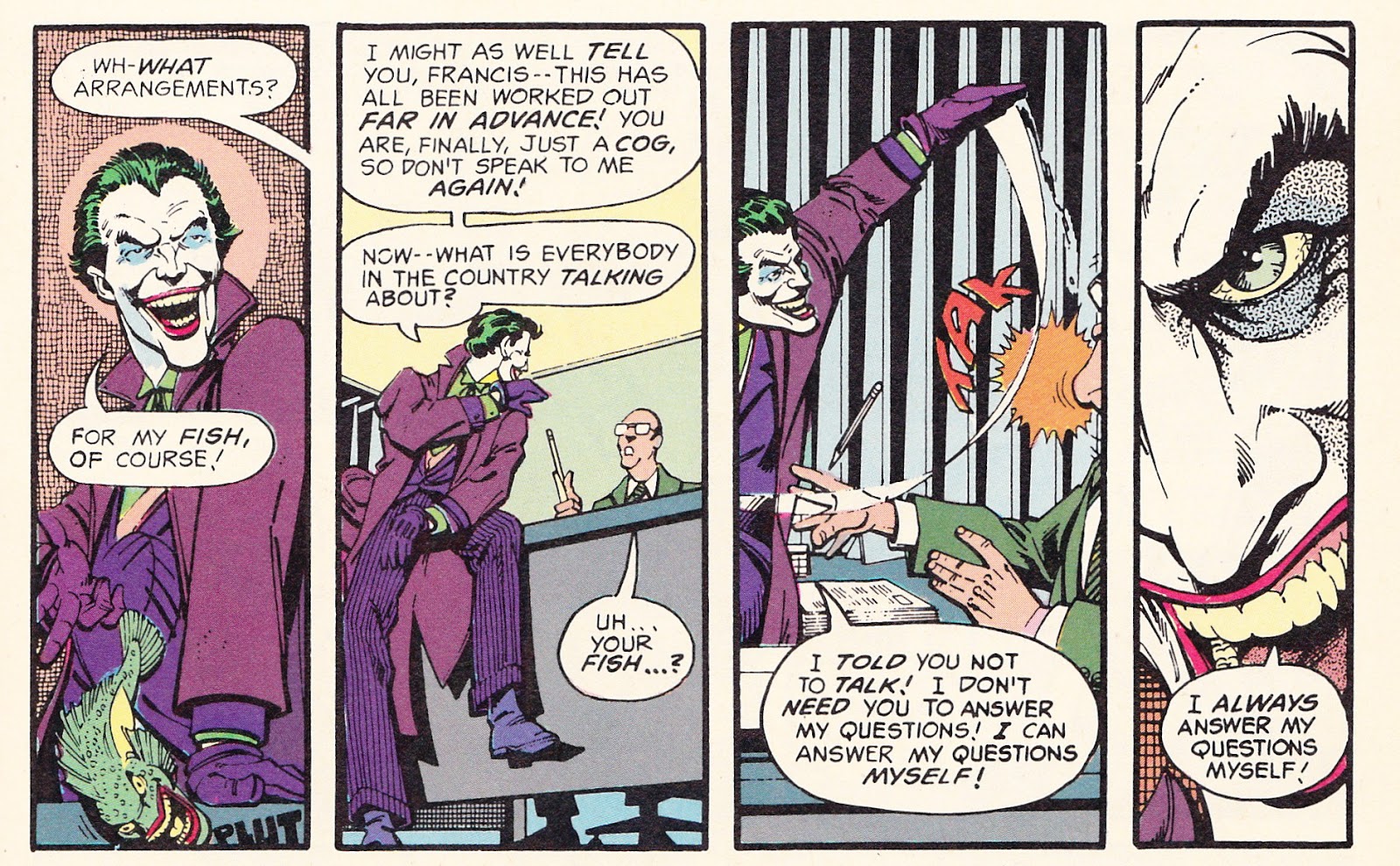
The character of The Batman has inspired many fine interpretations by artists since his creation in the 1930s. One of these artist certainly has not gotten the respect and recognition in recent years that he deserves. Marshall Rogers (January 22, 1950 – March 24, 2007) came to prominence illustrating the Dark Knight in the pages of Detective Comics back in 1977-78. His collaboration with writer Steve Englehart was, for many years, held up as one of the shining moments in the character's history. 

While artists like Neal Adams presented a muscular Batman, Rogers' though was lanky, athletic, tall, but not bulky. His Joker, was as memorable: extremely thin, perfectly dressed, wide mouth revealing the whitest of smile. Perfectly creepy.

Not to be forgotten, Terry Austin's solid inking style gave Rogers' art an angular, precise quality that was integral to the look of the art. 

There is no currently available trade paperback or hardback collection on the market and honestly the production value on the latest incarnation was lackluster. I would urge you to seek out the last 4 issues of the reprint collection Shadow Of The Batman, published back in 1985. In those, Rogers had the opportunity to re-color the issues and the whole presentation was of high quality.
While Rogers continued producing work on a regular basis until his death in 2007, none of it quite achieved the high level of his Batman work.

Monday, August 1, 2016

WANTED

WANTED
Written by Mark MIllar and drawn by J.G. Jones. Published by Image Comics.

Cubicle-dwelling Wesley Gibson is a coward and he has a dull life. His girlfriend respects him so much she cheats on him with his best friend every chance she gets. He knows it, but he is in such a state of utter pussyness that he does not dare say, or do anything. He's treated like shit by his boss who ridicules him every chance she gets. He learns his father, recently killed, was one of the baddest super-villains of all time. In this world, the super-villains rule the earth from the shadows. They eradicated the goods guys (after a three months brawl in 1986!) and divided the world among themselves. The peace signed between them is rendered fragile by the death of The Killer (Wes' dad). Wesley learns the ropes of super-villainy in order to take the torch which he inherited. 
Wanted's humor is in the same vein as Millar's Authority run; black like the night. It is cynical, violent, with brains splattering everywhere. It is very indicative of a period in the writer's life when every character was tainted by darkness. Make no mistake about it, Wes is not a good guy and he does reprehensible thing throughout the story so your tolerance for following his journey might vary. However, there is a charm to the story, it evolves, moves and the characters, as bad as they all are, you just want to see how they all turn out, which makes all the difference. 

The drawings are dynamic, the graphic storytelling tight and well handled. The renderings attractive. When this was originally published, artist J. G. Jones was being praised as the next big thing (health issues have kept him out of the spotlight since then). Easy to understand by looking at the work in Wanted. 

Get the book here:

Friday, July 29, 2016

THE RED SNAKE

THE RED SNAKE

Written and drawn by Hideshi Hino

"For as long as I can remember I've always wanted to get away from this house"

A house so big that nobody knows its real dimensions, nor even visited all of its parts, a dilapidated maze encircled by an impenetrable forest: such is the oppressive stage of The Red Snake. The last born of an obviously disturbed family, no doubt from many generations of inbreeding, and obviously the most balanced inhabitants of the manor, this young boy penetrates in the heart of the residence, releasing by accident the demons which lives in it. The tone of the story is announced in its very first page as the boy stares into the immensity of the house. His grandfather has a large growth hanging from his jaw, his grandmother believes she is a chicken and lives in a nest, his father, who raises chickens with sadistic affection, aids her dementia by giving her baskets of eggs that he claims she laid herself, his mother tends to grandfather's boil with far too much tender loving care, and his sister fondles insects with erotic glee. As if the poor kid doesn't have enough to worry about, his grandfather tells him that the large mirror in their house is, in reality, a barrier that blocks the gates to Hell. 
Cartoonist Hideshi Hino presents a gallery of baroque characters all of them disturbing, touched by degradation (physical or mental). Among this ensemble, the principal character feels insulated, a prisoner of the house. The young narrator will soon become witness to the events which he started, and that he is unable to stop. The Red Snake can be seen as an allegory of a person retreating in oneself against an unbearable reality. An illusory refuge, leading quickly to psychosis, finishing in an inextricable loop in time that finds the central character in a mental prison quite as effective as the physical prison that was the house. 

In Hino's world, death is not an escape. Relying heavily on symbolism, The Red Snake is difficult to understand at times, the reader is confronted with the madness of the narrator and wonders where reality really is . Phantasm? Deformed actuality? One closes the book in a state of confusion. One thing is certain, The book is not read, it is experienced. It leaves the reader in shock, appalled at the horror, the strangely erotic danse macabre that the characters play with each other. Hideshi Hino is a terribly effective horror writer & artist. The works is both repugnant and attractive. The faintness which one feels while reading The Red Snake is the best proof of an immense storyteller.

The book is no longer in print but can be found second hand on Amazon or EBay.